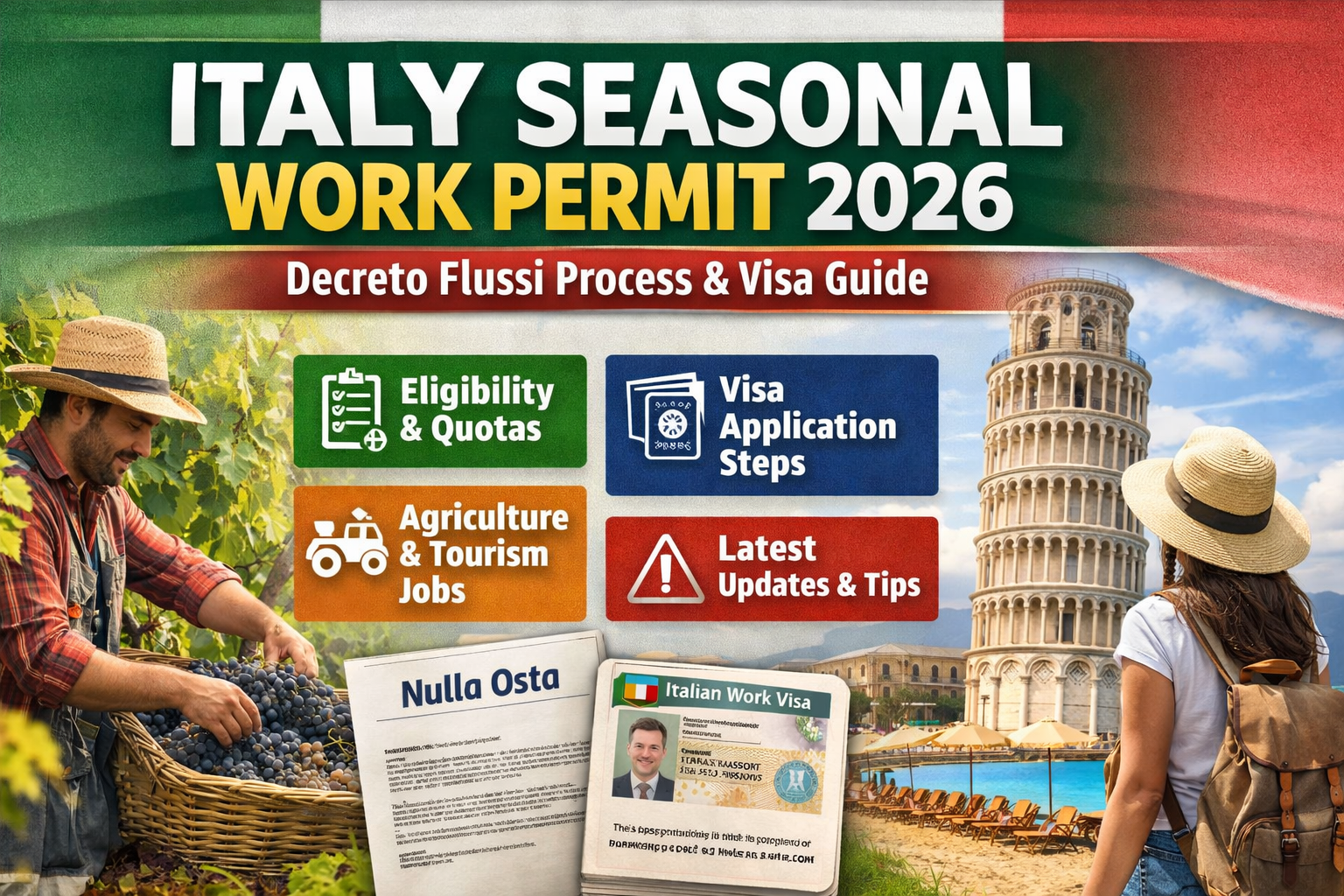
Italy Seasonal Work Permit 2026 – Decreto Flussi, Requirements, Application Process
Every year, Italy provides non-EU citizens with seasonal work opportunities with the help of its official quota program called Decreto Flussi. Under the seasonal employment scheme, thousands of foreigners will be employed in the agricultural and tourism industries in Italy in 2026.
In the case that you are thinking of working in Italy on a temporary basis, the following guide elaborates the procedure that is officially to be followed, rules of eligibility, documentation required, quota system and significant updates, strictly on the basis of government procedures.
What Is Italy Seasonal Work Permit?
The Italy Seasonal Work Permit which is also known as Lavoro Stagionale enables the non-EU citizens to work in Italy with a restriction in time in certain fields where labor demand is higher during some seasons.
Permits on seasonal basis are usually allocated to:
- Farming (harvesting, agriculture, farmland, vineyards)
- Tourism and hospitality (hotels, resorts, restaurants)
In comparison to permanent work permits, seasonal ones are temporary exception that is associated with a particular employer.
Knowing Decreto Flussi 2026
What Is Decreto Flussi?
Decreto Flussi is the name of the yearly immigration quota decree of Italy. The Italian government has a fixed amount of work permits that can be issued to non EU nationals every year.
The decree determines:
- Total seasonal worker quota
- Sectors eligible
- Countries allowed to apply
- Application opening dates
When the government declares the actual application period, employers have to apply within the quota limits.
Who is eligible to Italy Seasonal work permit?
You may qualify if:
- You are a non-EU citizen
- You are offered employment by an Italian employer.
- Your employer utilizes on the formal quota system.
- You fulfill visa and documentation restrictions.
Important:
You cannot apply without the support of an employer. Italian employer has to start the process.
Areas that are included in seasonal employment
Agriculture Sector
Common jobs include:
- Picking of fruits and vegetables.
- Winemaking and viticulture.
- Olive picking
- Greenhouse work
Such jobs are normally provided at the time of planting and harvest.
Tourism & Hospitality Sector
Jobs may include:
- Hotel staff
- Restaurant workers
- Resort maintenance staff
- Employees in beach and ski resorts.
Summer and winter peak seasons are the areas where seasonal jobs in tourism are characterized.
Application Process Step by Step
The process of seasonal work is official since it takes steps on a government manner:
Step 1: Under decree Flussi is applied by the employer.
The Italian employer makes an online application on the immigration portal within the formal quota period.
They are asking a work authorization known as:
Nulla Osta al Lavoro
Step 2: Issuance of Nulla Osta
Should be passed during the quota limit:
- Nulla Osta approval is granted to the employer.
- The paper is submitted to the appropriate Italian embassy.
Step 3: File visa application to Italy Type D Visa.
The employee then requests a Type D Long-Stay Work Visa in the Italian embassy or the Italian consulate of his home country.
Commonly necessary documents are:
- Valid passport
- Work contract
- Nulla Osta approval
- Visa application form
- Evidence of accommodation (meeted by employer)
- Health insurance (where necessary)
- Visa fee payment
Step 4: Arrival in Italy and Residence Permit.
After arriving in Italy:
- The employee should be able to sign the house agreement.
- Request a Permesso di Soggiorno (Residence Permit) in 8 days.
This completes the legal stay.
Documents to be required in Italy Seasonal Work Visa
From the Employer:
- Signed employment contract
- Proof of accommodation
- Nulla Osta approval
- Proof of financial capacity
From the Worker:
- Valid passport
- Visa application form
- Photos
- Medical insurance (where necessary)
Supporting identity documents
Processing Time Overview
Processing time is also dependent on:
- Quota demand
- Embassy workload
- Document accuracy
Typically:
- Approval can require weeks on the part of the employer.
- It can also take more weeks to process the visa.
Submission at an early stage within quota window has high probabilities of passing.
Validity of Seasonal Work Permit
The general seasons and permits that are allowed include:
- A maximum of 9 months in 12 months.
The precise time period is dependent on:
- Employment contract
- Sector
- Conditions of the government decree.
The permits are seasonal and associated with the employer.
Is an extension of Seasonal Work Permit possible?
Extrapolations can make sense provided by legal constraints, however:
- You have to remain within seasonal laws.
- Conditions of extension rules are based on annual decree.
This is because some of the workers can subsequently become eligible to be converted to non-seasonal work permits should they qualify under new quotas.
Never forget to consult official announcements on rules of conversion.
Salary and Conditions of Work
The Italian labor laws cover seasonal workers.
Employers must provide:
- Legal employment contract
- Minimum wage based on industry deals.
- Safe working conditions
- Uproper accommodation (when provided)
Workers are entitled to:
- Fair wages
- Regulated working hours
- Social security (where applicable).
Important Things to Avoid
To remain as a law-abiding citizen and not to be refused the visa:
- Not applicable unless sponsored by the employer.
- Never use unofficial agents who assure of approval.
- Do not use unofficial quota numbers.
- Make sure that documents are correct and comprehensive.
- Check the due dates through official portals.
Italy Seasonal Work Permit 2026: Major Considerations to Keep in mind
- The seasonal permits are in the form of quotas.
- Employer must apply first.
- Upon Nulla Osta approval, worker applies to the visa.
- Validity maximum (not more than 9 months).
- Major sectors are agriculture and tourism.
- The requirements can vary on an annual basis.
FAQs
-
Will Italy Seasonal Work Permit be open in 2026?
The permit is opened on a yearly basis through Decreto Flussi. The Italian government announces the official opening dates every year.
-
Is it possible to apply without employment offer?
No. An Italian offer of employment is obligatory.
-
What number of quotas do we have?
The quotas vary with every year and are established on the official Decreto Flussi announcement.
-
What is Nulla Osta?
Nulla Osta refers to work permits granted by the Italian immigration departments to a foreign worker so that they can obtain a visa.
-
What is the duration of seasonal visa?
The period of seasonal permits is usually 9 months in a year.
-
Is it possible to use my family on a seasonal permit?
Seasonal permits in most cases do not enable family reunification because they are temporary.
-
Is it possible to have seasonal work permit converted into permanent work?
Conversion can be had in certain instances with new quotas, but this again is based on official annual regulations.
-
What industries are recruiting seasonal employees?
Agriculture and tourism/hospitality are the key industries.
Final Thoughts
Italy has been providing legal and organized temporary working opportunities to foreign workers in the form of Seasonal Work Permit under the annual system of Decreto Flussi. It needs employer sponsorship, compliance to quotas and documentation.
If you are planning to apply in 2026, monitor official government announcements closely, prepare documents in advance, and avoid unofficial shortcuts.
Seasonal work permits can provide valuable international experience, but staying informed and compliant with official procedures is essential for success.